
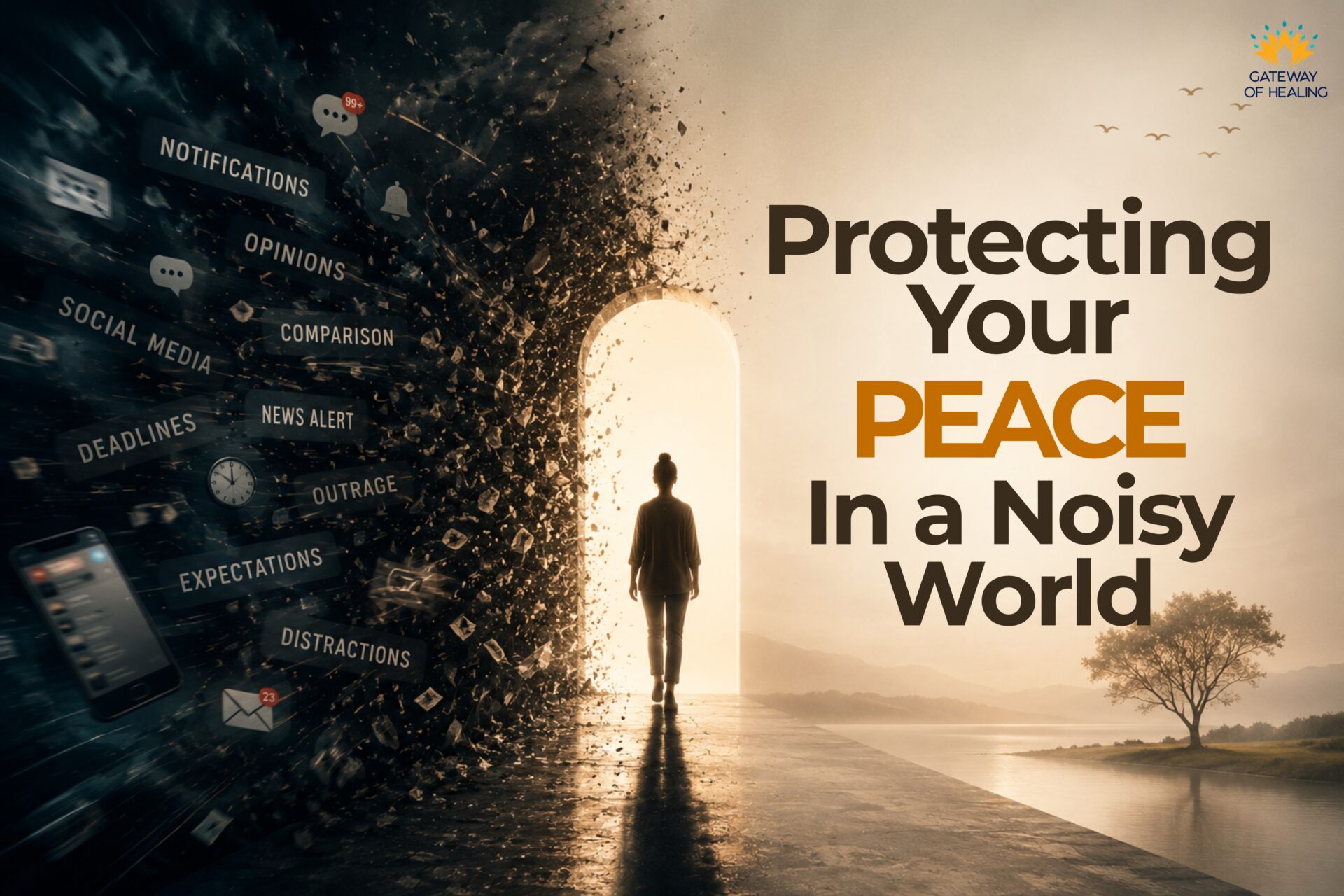
We live in a world that rarely stops talking. Notifications demand attention before we’ve even finished our morning coffee. Opinions arrive faster than we can process them. News cycles move at dizzying speed. Social media tells us what to think, what to buy, how to look, and even how to feel. Somewhere in all that noise, many people have lost their peace. Not because life has become impossible, but because their attention is constantly being pulled in every direction. They react before they reflect. They absorb emotions that are not theirs. They confuse being informed with being overwhelmed. Protecting your peace is not about disconnecting from the world, but about learning to stay connected to yourself while living in it.
Peace Is Not the Absence of Noise
Many people believe they will feel peaceful when life becomes less busy, when work settles down, when their children grow up, when finances improve, or when everyone around them changes. But peace that depends entirely on external circumstances is fragile. True peace is the ability to remain centred even when life is unpredictable. It is not the absence of challenges, but the presence of inner stability.
Your Attention Is Your Most Valuable Resource
Every day, countless things compete for your attention, including emails, headlines, messages, and algorithms designed to keep you scrolling. Every time your attention is pulled outward, your inner world becomes easier to ignore. Eventually, you may notice:
- Difficulty concentrating
- Mental fatigue
- Emotional irritability
- Feeling constantly “switched on”
- Struggling to enjoy moments of stillness
Not Every Opinion Deserves a Place in Your Mind
We have unprecedented access to other people’s thoughts, which can be enriching, but also profoundly exhausting. Without realising it, many people quietly carry a heavy load of external noise, other people’s fears, expectations, outrage, and definitions of success. When every passing opinion is given equal importance, your own inner voice becomes difficult to hear. Real wisdom, therefore, is not about consuming more information; it is about cultivating the discernment to know what truly deserves your attention.
Your Nervous System Wasn’t Designed for Constant Input
The human nervous system evolved to respond to immediate challenges. Today, it often reacts to endless digital stimulation instead. Constant alerts, breaking news, and continuous comparison keep the brain in a state of heightened alertness. Over time, this may lead to:
- Feeling emotionally drained
- Difficulty relaxing
- Restlessness
- Increased anxiety
- Trouble sleeping
This does not mean technology is harmful, but it means your nervous system also needs periods of quiet to recover. Peace is not a luxury, rather a part of emotional regulation.
Boundaries Protect More Than Your Time
Many people think boundaries are strictly about saying no to others, but healthy boundaries do so much more, they protect your emotional energy, attention, mental clarity, values, and capacity to respond thoughtfully rather than react impulsively. Because every unnecessary commitment, petty argument, or hollow obligation consumes precious internal space, protecting your peace often means simply choosing not to engage. Remember:
- Not every invitation requires an acceptance.
- Not every debate requires your participation.
- Not every message requires an immediate reply.
Inner Peace Is Built Through Daily Choices
Peace is rarely created by a single, monumental decision; rather, it grows through small, consistent daily habits. The way you begin your morning, the conversations you entertain, the people you spend time with, the content you consume, and the thoughts you repeatedly believe, these subtle choices continuously accumulate, quietly shaping the baseline of your emotional environment
Practical Ways to Protect Your Peace.
- Create moments without input. Spend at least a few minutes each day without a screen, music, podcasts, or conversation. Allow your mind to settle, as clarity often appears in silence.
- Choose what deserves your attention. Before engaging with information, ask yourself:”Will this inform me, or simply overwhelm me?” Not everything needs your emotional investment.
- Learn to pause before reacting. A pause creates choice, whether responding to criticism, disappointing news, or conflict, taking a few slow breaths allows your nervous system to settle before you respond.
- Protect your emotional environment. Notice how you feel after spending time with certain people or consuming certain content. Choose relationships and information that leave you feeling grounded rather than depleted.
- Reconnect with what brings you back to yourself. For some, it is meditation, while for others, it is prayer, journaling, walking in nature, reading, or simply sitting quietly with a cup of tea.
Peace Is Not Passive
There is a common misconception that peaceful people avoid difficult conversations or uncomfortable decisions, but the opposite is often true. Those who actively protect their peace communicate honestly, set clear boundaries, walk away from unnecessary conflict, make decisions strictly aligned with their values, and accept that they cannot control everything. Far from being a weakness, true peace is emotional strength expressed with calm conviction rather than force.
Your Inner World Shapes Your Outer World
Many people spend years trying to organise their external life while neglecting their internal one. Yet your inner state influences:
- How you respond to setbacks
- How you experience relationships
- How you make decisions
- How you lead
- How you recover from stress
When your inner world feels chaotic, even beautiful moments become difficult to enjoy, but when your inner world feels steady, challenges become easier to navigate. Protecting your peace is not escaping reality, because it is changing the place from which you meet it.
A Daily Peace Practice
Before ending your day, take five quiet minutes, and ask yourself:
- What drained my energy today?
- What helped me feel calm?
- What can I let go of before tomorrow?
- What deserves my attention, and what does not?
Take three slow breaths, and imagine placing everything that no longer serves you outside the door of your mind, because tomorrow is a new beginning.
Frequently Asked Questions
Q1. Is protecting your peace the same as avoiding problems?
No. Protecting your peace means responding thoughtfully instead of reacting impulsively. It includes addressing problems without allowing them to consume your emotional well-being.
Q2. Why does constant digital stimulation feel so exhausting?
Continuous notifications, information, and comparison can keep the nervous system in a heightened state of alertness, making it difficult to rest and recover.
Q3. How do boundaries support emotional well-being?
Healthy boundaries protect your time, energy, attention, and mental clarity, allowing you to focus on what truly matters.
Q4. Can I stay informed without becoming overwhelmed?
Yes. Choose trusted sources, set limits on news consumption, and balance information with activities that restore your emotional energy.
Q5. What is one simple habit that supports inner peace?
Creating even ten minutes of uninterrupted quiet each day can help calm the mind, regulate the nervous system, and reconnect you with yourself.
In a world that constantly competes for your attention, protecting your peace is one of the most meaningful acts of self-care. It is not about shutting the world out or pretending challenges do not exist. It is about choosing, again and again, what deserves a place in your mind and heart. The quieter your inner world becomes, the more clearly you can hear your own wisdom. And in that clarity, you discover that peace is not something you find someday. It is something you practise every day.
Reach Dr. Chandni’s support team at +918800006786 and book an appointment.































 facebook
  X
X  youtube
  whatsapp
  instagram
  linkedin
Sometime we forget that peace comes from inside, not from outside.
This was a beautifull read… thanks
Peace is so importent in todays noisy env…
Good article with some realy practical ideas
never thought abt peace in this way before. Very intresting
realllly liked this…. We all need to learn how to protect our inner peace