
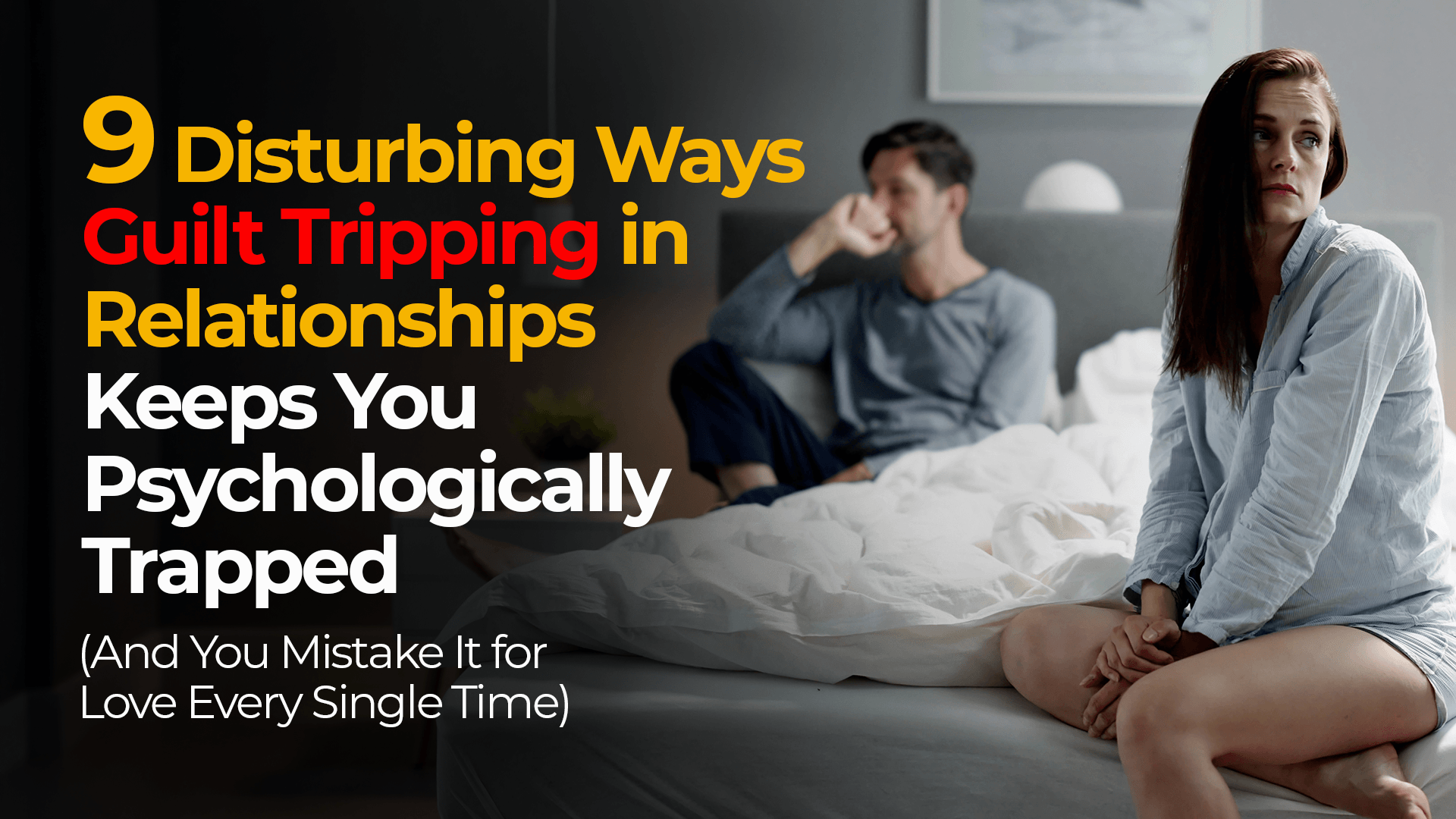
You are not weak. You are not stupid. You are not broken. You are engineered.
Why does the person who hurts you the most also feel like the one person you cannot live without?
Why does prioritizing yourself feel like committing a crime against someone you love?
Why does leaving a relationship that clearly damages you feel morally worse than staying inside it?
Read every word of what follows. Because what you are about to understand is not just an explanation of your past. It is the dismantling of a psychological architecture that was built inside you, brick by invisible brick, possibly over years. Guilt tripping in relationships is not a communication flaw. It is a control system. And it is running quietly in the background of your life right now.
Manipulation is nothing like what films and television taught you. There is no villain who raises his voice and slams his fist. There is no ultimatum delivered across a dramatic silence. The truly dangerous manipulators never threaten you. They discovered something far older, far quieter, and neurologically far more effective than fear.
They discovered guilt. And they weaponized it inside the spaces you trusted most.
Here is the thing that makes this so insidious. Guilt does not feel like control. It feels like conscience. It feels like love. It feels like you caring about another human being the way decent people are supposed to. That feeling of decency is exactly what is being exploited against you.
This is the science, the psychology, and the brutal truth of how guilt tripping in relationships actually works.
1. They Chose Guilt Over Threats Because Your Brain Was Always the Easier Target
A direct threat is, psychologically speaking, a rookie move. Any trained psychologist will tell you that threatening someone activates the sympathetic nervous system immediately. That is the brain’s fight-or-flight circuitry. The body runs a clean, fast, biological calculation. The source of pain is outside me. I can move away from it.
This is exactly why threats fail as long-term control mechanisms. They reveal the predator. They create distance. They give the victim something concrete to point at and name.
Guilt operates on an entirely different neurological frequency. Guilt does not originate outside you. It is generated inside you, by you, and most devastatingly, it feels like it is about you.
“I’m not angry. I’m just tired of always being the one who loves more in this relationship.”
“No, go. Enjoy yourself. I’ll sit here and figure it out alone like I always do.”
“I never ask for anything. I just assumed after all this time, you knew how much I needed you tonight.”
Not one of those sentences is a threat. Every single one of them is a scalpel. And here is the neurological truth that reframes everything. Shame and guilt activate the brain’s anterior cingulate cortex, which is the same region responsible for processing social pain. Neuroscience has confirmed that social pain and physical pain share overlapping neural pathways. The guilt you carry in your chest is not metaphorical suffering. It registers in your brain with the same urgency as a physical wound.
The biological response to unresolved pain is not escape. It is repair. Your nervous system needs the pain to stop, and the fastest route to stopping guilt is returning to the person who planted it and making things right. You do not flee the prison. You renovate it and call it a home.
2. They Built an Emotional Debt So Large You Could Never Afford to Walk Away
Watch this pattern closely, because you have lived through it and you may have called it love at the time.
They gave generously in the beginning. Extravagantly, even. Time, attention, sacrifice, presence during your worst moments. They showed up when it cost them something. And they never let you forget it, not loudly, not crudely, but consistently, like a slow drip that fills a room you did not know you were standing in.
“I gave up that job opportunity to be closer to you. I never even told you that.”
“I cancelled my plans every time you called. Not once did you even notice.”
“I have poured everything I have into this. I just thought that meant something to you.”
This is what psychologists and behavioral researchers call obligation architecture. Robert Cialdini, whose decades of research on influence and social reciprocity became foundational reading in psychology, documented that human beings carry a deep and almost primal compulsion to return what they receive. The Reciprocity Principle is not a social nicety. It is hardwired into our species. Communities that did not practice it did not survive long enough to leave descendants. The instinct runs ancient and deep inside every one of us.
Manipulators exploit this ancient wire with extraordinary patience. They do not call the debt in immediately. They let it accumulate. By the time they begin collecting, you feel as though you have been living on borrowed grace for years. Leaving does not feel like a personal decision. It feels like theft. Like fraud. Like abandoning someone who built their life around your gratitude and then found out it was never real.
3. They Quietly Rewired Your Conscience Until It Started Working for Them Instead of You
A healthy conscience is among the most remarkable features of human psychology. It is your internal moral compass, calibrated by experience and values, designed to alert you when you have genuinely caused harm so that you can repair it and grow. It exists to serve your integrity. A skilled manipulator does not destroy your conscience. Destroying it would be obvious, and obvious is the one thing they cannot afford to be. Instead, they reprogram it.
“I never thought of you as someone who just disappears when things get difficult.”
“The person I fell in love with would never make me feel this invisible.”
“I’m not saying you’re a bad person. I’m just saying that good people don’t do what you just did.”
Through sustained cycles of emotional withdrawal, strategically timed disappointment, and carefully performed vulnerability, they install a new operating rule in your conscience without you ever being aware of the installation. The rule is this. Your primary moral duty is to keep this specific person emotionally comfortable at all times, regardless of the cost to yourself.
They never announce this rule. They simply respond with unmistakable pain every single time you prioritize yourself. And they respond with warmth, relief, and reconnection every time you abandon your own needs to serve theirs. Over months and years, your brain forms a hardwired conditioned association. Self-prioritization triggers guilt. Self-sacrifice produces relief. Pavlov rang a bell and produced saliva. They used silence and sighs and produced the same result with greater precision.
4. They Made You the Villain of a Crime You Never Actually Committed
Pause on this one. Really pause.
In a relationship defined by guilt tripping and emotional manipulation, the person being controlled almost never identifies themselves as the victim. They identify as the problem. They are the one who is not trying hard enough. The one whose love is never quite sufficient. The one who, despite all evidence, keeps finding ways to disappoint someone who deserves so much better.
“Even my friends feel sorry for me because of how you treat me. But I still defend you to all of them.”
“I don’t need you to apologize. I just need you to understand what you put me through.”
“You know the saddest part? I would still do anything for you. That’s what’s pathetic about me.”
This inversion is not accidental. It is the central and most devastating achievement of guilt-based psychological control. When you are afraid of someone, the moral architecture stays intact. You know who the threat is. You name it. You tell people. You eventually leave. But when you feel guilty toward someone, the entire moral architecture reverses. You are not a person protecting themselves from harm. You are a person trying to make amends for harm you have caused.
Psychologists call this DARVO, which stands for Deny, Attack, Reverse Victim and Offender. The person responsible for causing damage flips the relational dynamic so completely and so efficiently that the actual victim ends up defending their abuser to others, dismissing outside concern, and fighting their own instinct to leave. The manipulator never has to play the villain. You volunteered for that role. And you defend it fiercely, even against the people who love you and are trying to pull you out.
5. They Turned Your Empathy Into the Sharpest Weapon in the Room
Here is the brutal irony at the center of every guilt-based toxic relationship. The more emotionally intelligent you are, the more empathetic and attuned and sensitive to others’ pain, the more catastrophically vulnerable you are to this specific form of control.
Manipulators do not find empaths by accident. Empathy creates a direct, unprotected channel from another person’s emotional state into your own nervous system. When they perform sadness, you do not just register it intellectually. You feel a version of it yourself. When they display disappointment, it does not land as information. It lands as sensation, somewhere in the chest or the throat.
“Look at you. Perfectly fine. Meanwhile I’m sitting here barely holding myself together.”
“I’m not asking you to fix anything. I just wanted to know you cared. But clearly that was too much to hope for.”
“You’ll never understand what it feels like to love someone the way I love you and still feel completely alone.”
Neuroscientist Jean Decety’s landmark research on empathy demonstrated that highly empathetic individuals show mirror-like neural activation when they witness another person’s distress. The suffering is not entirely foreign to you. You experience a version of it. This is a beautiful feature of human connection in healthy relationships. In a manipulative one, it is a remote control in someone else’s hands.
They do not have to ask you to stay. They simply have to look like they will collapse if you go. Your nervous system, wired beautifully for compassion and human connection, does the rest of the work without being asked. Your greatest strength became the mechanism of your imprisonment.
6. They Spoke the Language of Sacrifice So Fluently You Could Never Call It Manipulation
This is the section to read with full attention, because these are real sentences, and you have heard versions of them.
- “I just thought I meant more to you than this. I suppose I was wrong about what we had.”
- “After everything I’ve given to this relationship, I never imagined I’d feel this alone in it.”
- “I’m not angry. I’m just disappointed. And honestly, disappointment is so much worse.”
- “Go. Honestly, go. I’ll manage. I always do.”
- “I never asked for anything in return. I thought love worked that way. Apparently not for everyone.”
Search every one of those sentences for a threat. You will not find one. Search for a direct demand. Also absent. There is nothing concrete to point at. Nothing that sounds unreasonable when read aloud to someone else. Each sentence performs vulnerability so convincingly that naming it as manipulation makes you sound paranoid, cold, and cruel.
This is weaponized vulnerability, and it is among the most trending concepts in relationship psychology right now precisely because so many people are finally recognizing it in their own lives. The language of sacrifice is manipulation wearing the most convincing costume available. Love. It is impossible to argue against because arguing against someone’s stated pain requires a level of emotional detachment that decent, empathetic people simply cannot perform without betraying their own values.
So you absorb it. You reassure them. You adjust, apologize, and give more. And they received exactly what they wanted without placing a single direct demand on the table.
7. They Made the Most Painful Cycle of Your Life Feel Like the Most Intimate Thing You Ever Experienced
This is where it becomes genuinely difficult to untangle, and this is the section that matters most for people currently inside a toxic relationship pattern they cannot seem to exit.
The guilt cycle does not feel like emotional abuse. Large and significant portions of it feel like the deepest intimacy you have ever known.
“When he finally held me after days of silence, I felt closer to him than I’d ever felt to anyone.”
“The moment I apologized, she became warm and present in a way she almost never was otherwise. I lived for those moments.”
“Every time we came back together after one of those terrible periods, it felt like proof that what we had was real and worth fighting for.”
This is intermittent reinforcement, and it is, without question, the most addictive behavioral pattern documented in human psychology. B.F. Skinner’s foundational research on variable reward schedules demonstrated that unpredictable rewards produce dramatically stronger behavioral persistence than consistent ones. This is why slot machines are engineered to pay out randomly rather than on a predictable schedule. Uncertainty is the hook. Guilt-based toxic relationships operate on exactly the same principle.
The warmth that follows the guilt cycle is not an accident of affection. It is the hook. It floods your brain with dopamine and oxytocin at the precise moment your nervous system is most desperate for relief. Your brain begins to associate the suffering with an eventual reward so potent that the pattern becomes self-sustaining. You are not in love with this person the way you think you are. You are neurochemically addicted to the cycle they created.
8. They Booby-Trapped the Exit Door With Shame So You Would Never Walk Through It
By the time you have lived inside guilt tripping and gaslighting long enough, leaving does not feel like self-preservation. It does not feel like a boundary. It does not feel like the healthy, necessary act that every therapist and every trusted friend in your life is telling you it is.
It feels like abandonment. Betrayal. Proof of everything you feared about yourself.
“So after everything, you’re just going to walk away. Just like that.”
“I always knew somewhere deep down that you were the kind of person who leaves when things get hard.”
“Go. But look me in the eye and tell me you know what you’re doing to me right now. Look at me and choose this.”
Every genuinely healthy relationship permits exit. You can leave a job, a friendship, a city, and while grief and complexity follow, you do not feel like a criminal on the way out. In a relationship built on guilt-based emotional manipulation, the exit is booby-trapped with identity. They have spent months or years ensuring that your sense of self, your understanding of what kind of person you are, is partially constructed around your loyalty to them.
Leaving dismantles a piece of who you believe yourself to be. The shame of that collapse is so overwhelming, so unbearable, that many people rationally choose to remain inside the suffering rather than face what departure seems to confirm about their character.
The door has always been unlocked. Every single day, it has been unlocked. But they convinced you that the act of walking through it proves every terrible, secret thing you have ever feared about yourself. That is not love. That is a cage built entirely from your own self-concept.
9. The Most Chilling Truth Is That Many Manipulators Learned All of This Before They Were Old Enough to Ride a Bicycle
Prepare yourself for this one. Because it will make you feel something genuinely complicated, and complicated feelings are where the real healing begins.
Not every person engaged in guilt-based manipulation designed this system consciously. Many of them, perhaps most of them, learned it in childhood. They grew up inside homes where emotional pain was the primary currency of communication. Where guilt was not a weapon pulled out for special occasions but the ambient language of every relationship in the house.
“My mother would go completely silent for three or four days whenever I did something she disapproved of. I grew up believing that was what love looked like.”
“He genuinely believed he was the one being abandoned every time I tried to set a limit. His confusion wasn’t performance. That was the most disorienting part of all.”
“She cried when I left. Real tears. And she genuinely could not understand why what she was doing was harmful. She thought she was just loving me.”
This does not change the impact. The harm you experience is completely identical whether the manipulator has full awareness or none whatsoever. But it means that some of the most damaging people in your life are also deeply convinced that they are the ones being wronged. They genuinely experience their guilt-inducing behavior as love. They genuinely feel wounded when you resist it. And your empathy, which is legitimate and real and one of the best things about you, will whisper without stopping that they deserve your patience.
They may deserve compassion. What they absolutely do not deserve is your continued compliance.
What Actually Helps After You Understand This
Understanding the psychological architecture of guilt tripping in relationships will not immediately dissolve the guilt you feel. Insight and healing operate on completely different timelines, and anyone who tells you otherwise has not done real therapeutic work. But knowledge creates a shift that nothing else can replicate. It gives you a name for what was nameless. And named things lose a significant portion of their power.
The guilt you feel about choosing yourself is not evidence that you are wrong. It is evidence that you were trained by someone whose emotional survival depended on your believing you were wrong.
The physical discomfort that arrives when you set a boundary is not your conscience firing. It is a conditioned reflex in a nervous system that was systematically taught to equate self-preservation with cruelty.
What the research and clinical evidence consistently supports:
- Somatic therapy and attachment-based therapy, because guilt tripping leaves traces in the body that talk therapy alone cannot always reach
- Learning to distinguish between guilt that signals genuine wrongdoing and guilt that was installed by another person’s unmet emotional needs
- Building tolerance for being perceived as the difficult one or the bad one, because that specific fear is the entire foundation on which the manipulator’s control was constructed
- Recognizing that another person’s pain in direct response to your boundary does not make the boundary wrong
- Sitting with discomfort without immediately rushing to resolve it, because the rush to resolve is the reflex they spent years conditioning in you
Frequently Asked Questions About Guilt Tripping in Relationships
Q1. What is the difference between guilt tripping and genuine emotional expression?
A. Genuine emotional expression communicates hurt without attaching obligation. A person expressing authentic pain will say what they feel without implying that your response to their feeling is a measure of your worth or your love. Guilt tripping ties their emotional state directly to your behavior in a way that always positions you as responsible for their suffering. The clearest distinguishing question to ask is this. Does this person’s expression of pain leave me feeling motivated to understand them, or does it leave me feeling that I must comply or be condemned?
Q2. Can guilt tripping in relationships happen without the other person realizing they are doing it?
A. Yes, and this is among the most important things to understand. A significant portion of guilt-based emotional manipulation is entirely unconscious. The person doing it may have grown up inside a family system where guilt was the standard language of connection. They are not calculating their behavior. They are replicating the only relational model they were ever taught. Unconscious manipulation is still manipulation. The absence of malicious intent does not reduce the harm to the person on the receiving end.
Q3. Why is guilt tripping in toxic relationships so much harder to leave than overtly abusive ones?
A. Because it never gives you a clean villain. Physical abuse or direct threatening behavior creates a legible enemy. The person’s cruelty is visible, nameable, and something others can validate immediately. Guilt-based manipulation leaves no visible marks. It systematically repositions you as the source of harm in the relationship. By the time most people recognize the pattern, they have already spent years defending the person who was controlling them and apologizing to the person who was causing the damage.
Q4. Is gaslighting related to guilt tripping?
A. They frequently occur together and are both forms of emotional manipulation, though they work through different mechanisms. Gaslighting targets your perception of reality, making you question whether events happened the way you remember or whether your feelings are proportionate and legitimate. Guilt tripping targets your moral identity, making you feel responsible for another person’s suffering. A relationship can involve both simultaneously, with gaslighting used to undermine your confidence in your own experience while guilt tripping ensures you stay engaged in attempting to repair a relationship you are not actually damaging.
Q5. How do you respond to guilt tripping without escalating the situation?
A. The most effective response is also the most counterintuitive one. Stop explaining yourself. Guilt tripping derives its power from your engagement with the premise that you owe an explanation or a defense. Every explanation you offer is treated as evidence to be used against you. A calm, brief acknowledgment of their feeling without accepting responsibility for it is often far more effective. Something like, ‘I can hear that you’re upset. My decision isn’t changing.’ The discomfort you feel in that moment is not a signal that you are wrong. It is the conditioned reflex recognizing that it is not being obeyed.
The Last Thing You Need to Hear
The manipulator never needed chains. Chains are obvious and obvious people get reported, confronted, left. What they needed was for you to believe, at a level beneath conscious thought, that your own goodness required your continued presence in their life regardless of what that presence cost you.
That belief was constructed. It was not discovered. It was not revealed by experience. It was installed, incrementally, through the very mechanism this article has spent considerable length describing.
You were not weak for believing it. You were human. Extraordinarily human. Capable of empathy and loyalty and self-sacrifice in ways that most people never fully access. Those qualities are not the problem. The problem was that someone found those qualities and decided to use them as a control mechanism rather than honor them as the gifts they genuinely are.
Guilt tripping in relationships does not end when you understand it. But understanding is always, without exception, where freedom begins.
What you do next belongs entirely and finally to you.
Reach Dr. Chandni’s support team at +918800006786 and book an appointment.




































 facebook
  X
X  youtube
  whatsapp
  instagram
  linkedin