
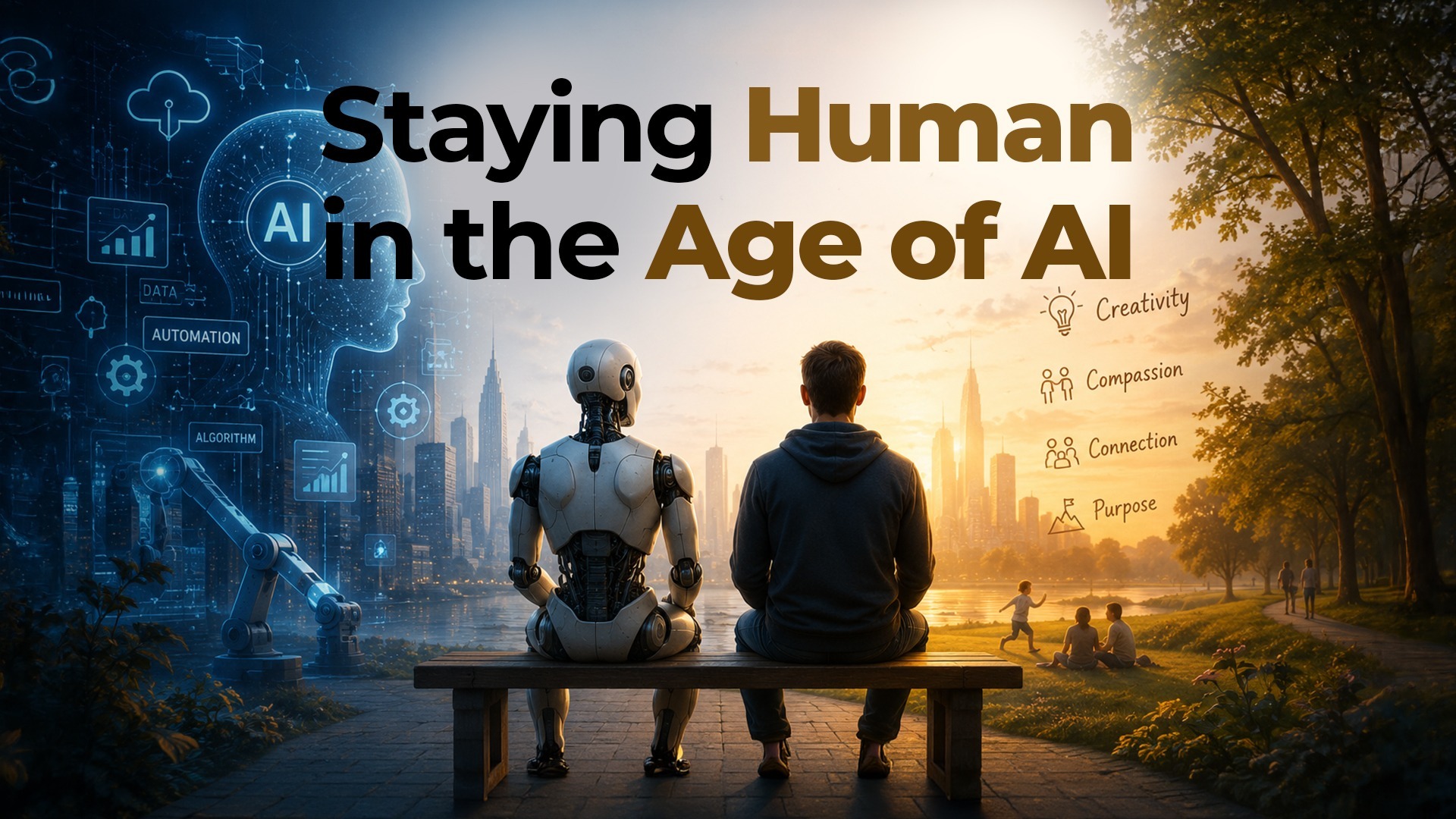
Artificial Intelligence is changing the way we work, communicate, learn, and create. Tasks that once took hours can now be completed in minutes. Information is now more accessible than ever, and automation is becoming part of daily life. These advancements bring exciting possibilities, but they also raise an important question, As technology becomes more intelligent, how do we stay deeply human?
The conversation about AI often focuses on what machines can do, and less attention is given to what makes human beings irreplaceable. In a world increasingly shaped by algorithms, the real challenge is not competing with technology, but staying connected to the qualities that technology cannot replicate.
The Human Experience Cannot Be Automated
AI can process information, analyse patterns, and generate content, but it does not experience life. It does not feel heartbreak, joy, grief, wonder, or love. It does not sit with uncertainty, navigate personal growth, or find meaning through lived experience, as human beings do.
Your greatest strengths are not your ability to process data quickly. They are your ability to connect, empathise, imagine, and create meaning. These qualities become even more valuable as technology advances.
The Risk of Constant Efficiency
Modern culture already glorifies productivity, and AI has accelerated this trend. Today, there is pressure to always work faster, produce more, optimise everything, and reduce effort wherever possible. While efficiency certainly has its benefits in the workplace, treating it as the ultimate goal of human existence comes with a steep cost;
- Deep relationships cannot be fast-tracked; they require time, presence, and shared experiences.
- Healing follows its own unpredictable timeline, resisting any attempts to streamline the process.
- Creativity thrives on experimentation, tangents, and the freedom to make messy mistakes.
- Self-discovery is a lifelong journey of trial and error, not a problem to be optimised.
Why Emotional Intelligence Matters More Than Ever
As technology becomes more capable, emotional intelligence becomes increasingly important. The ability to understand emotions, navigate relationships, communicate effectively, show empathy, and build trust cannot be outsourced. In workplaces, families, and communities, people remember how they felt around you far more than they remember information you shared. Human connection remains one of the most powerful forces in the world.
The Nervous System Was Not Designed for Constant Input
AI-powered tools have made information available around the clock. While access to knowledge is valuable, constant input comes at a cost, and many people experience:
- Information overload
- Mental fatigue
- Reduced attention span
- Difficulty being present
- Increased anxiety
Your nervous system needs periods of stillness to process, integrate, and recover. Without those pauses, you become informed but disconnected. Connected to information, but disconnected from yourself.
The Difference Between Knowing and Understanding
AI can help you find answers, but understanding comes through experience. You can read about confidence, relationships, leadership, healing, and purpose, yet true understanding develops when you live those experiences yourself, because wisdom is not just information but information integrated through life. The future will not belong only to those who know the most. It will belong to those who know how to apply knowledge with awareness, compassion, and discernment.
Why Presence Is Becoming a Superpower
In a distracted world, presence has become rare, as many conversations occur while people check their phones, meals happen while scrolling, and moments pass without being fully experienced. Technology connects people globally, and yet many individuals feel disconnected locally. Presence means:
- Listening fully
- Paying attention intentionally
- Being engaged in the moment
These simple acts are becoming increasingly valuable, as people crave genuine attention more than ever.
The Importance of Creativity
AI can generate ideas based on existing patterns, as human creativity often emerges from lived experience, intuition, curiosity, and emotion. Creativity is born from:
- Personal stories
- Unexpected insights
- Emotional depth
- Imagination
The future is not about choosing between technology and creativity. It is about using technology while continuing to nurture original thought, and your perspective remains uniquely yours.
Protecting What Makes You Human
- Spend time without digital stimulation
- Prioritise real conversations
- Stay connected to your body
- Create instead of only consuming
- Practice self-awareness
Allow your mind space to wander, as many breakthroughs emerge during moments of quiet reflection.
Choose depth over constant connectivity as meaningful connections strengthen emotional well-being.
Walk, move, breathe, and notice physical sensations because it is the body that keeps you grounded in reality.
Write, paint, build, cook, garden, or explore, as creation keeps you connected to your unique expression.
Technology can tell you what is happening around you. Awareness helps you understand what is happening within you.
The Role of Purpose
One of the biggest questions AI cannot answer for you is ‘What gives my life meaning?’ Purpose is deeply personal, and it comes from values, contribution, relationships, growth, and service.
Technology can support your journey, but it cannot define your purpose. That responsibility remains beautifully human.
A Simple Reflection Practice
Take a few minutes today and ask yourself:
- What activities make me feel most alive?
- When do I feel most connected to myself?
- What qualities do I want to strengthen as technology evolves?
- Am I consuming more than I am creating?
Frequently Asked Questions
Q1. Should we be afraid of AI?
A. AI is a tool. The focus should be on using it consciously rather than fearing it.
Q2. What human skills will remain valuable?
A. Emotional intelligence, creativity, empathy, communication, adaptability, critical thinking are among some of the things that will always remain relevant and valuable.
Q3. Can technology affect mental health?
A. Yes. Excessive stimulation and constant connectivity can contribute to stress and overwhelm.
Q4. How can I stay present in a digital world?
A. Create intentional boundaries around technology and prioritise real-world experiences.
Q5. Will AI replace human connection?
A. No. Human relationships fulfil emotional needs that technology cannot replicate.
The age of AI is not a test of whether humans can outperform machines. It is an invitation to remember what makes us human in the first place. Your capacity to feel, connect, create, heal, love, and find meaning is not becoming less important, but it is becoming more important. As technology continues to evolve, the greatest opportunity is not to become more machine-like in your efficiency. It is to become more fully human in your awareness, presence, compassion, and authenticity.
Reach Dr. Chandni’s support team at +918800006786 and book an appointment.
































 facebook
  X
X  youtube
  whatsapp
  instagram
  linkedin